

There is a version of this ring most people picture immediately: three matching round diamonds in a straight line, center larger than the two sides, set in white gold or platinum. That version is beautiful and long-lasting. However, it is also only one of dozens of ways a three stone ring can be assembled and worn. The combination of shapes, stones, and proportions available in this design category goes considerably further than the phrase “past, present and future” tends to suggest.
This guide covers what a past present future ring means; where the symbolism comes from; what the current design landscape looks like; and how to choose a three-stone combination that actually reflects the people wearing it.
What Is a Past Present Future Ring?
A past present future ring is a piece of jewelry featuring three stones set in a continuous line, typically with a larger center stone flanked by two smaller accent stones. The three stone format is used in engagement rings, anniversary rings, milestone jewelry, and right-hand fashion rings. It is also called a trilogy ring.
The defining feature of the style is the three-stone architecture rather than any single stone choice. The stones can match in shape or combine different diamond shapes and colored gemstones. The center stone can be significantly larger than the sides, nearly equal in size, or graduated in a deliberate sequence. Browse the full collection of three stone engagement rings at Carat Diamonds to see the range of design options.
Symbolism Behind Three Stone Rings
The most widely recognized interpretation is that the three stones symbolize a relationship’s timeline. Each stone carries a distinct meaning.

The Past
The left stone represents everything that brought two people together. Shared experiences, memories, challenges navigated as a team, and the foundation that the relationship is built on. It is the part of the story that has already been written.
The Present
The center stone, typically the largest, represents the current moment. The commitment being made, the life being built today, and the love in its most active form. Many wearers see the center stone as the ring’s anchor because it is the most visually prominent.
The Future
The right stone represents what lies ahead. Shared goals, plans, family, milestones, and the open chapter that the two people are writing together. This stone is often seen as the most hopeful, symbolizing the future rather than the past or present.
Does Three Stone Ring Mean Past, Present and Future?
No. The past, present and future interpretation is the most widely recognized, but it is not a universal rule. Many wearers choose three-stone rings for entirely different reasons, and the symbolism is personal.
Other common interpretations include friendship, love and fidelity; two people and the relationship itself as the third element; three children or family members; faith-based meanings; or simply three meaningful chapters of a personal story. Some buyers choose the design purely for its visual balance and design flexibility. The meaning of a past, present, and future ring is ultimately whatever the people exchanging it decide it means. No authority defines this.
History Behind Past Present Future Ring
Three stone jewelry has a long history in fine jewelry design. Multi-stone rings, including three-stone configurations, were used in various European jewelry traditions before the twentieth century, often for sentimental or symbolic purposes.
The specific “past, present and future” marketing language as a widely recognized way of describing three stone engagement rings became notably prominent in the early 2000s through advertising campaigns that popularized the phrase as a commercial concept. The association between three stones and a relationship timeline was likely present in jewelry culture before formal marketing, but the current widespread recognition of the terminology owes a meaningful debt to that advertising era.
Today, the design is considered historically established and widely understood, regardless of how the phrase became popularized. The three stone format has remained in continuous use across engagement rings, anniversary bands, and milestone jewelry for well over a century in various forms.
Three Stone Ring Styles to Know
Three stone rings have evolved well beyond matching round-round-round combinations. The current design landscape includes a wide range of stone configurations and aesthetic directions.

Classic Three Matching Stones
The most traditional format uses three diamonds of the same shape, typically graduated in size with the center stone larger than the two matching sides. Round brilliants in this configuration produce symmetric, high-sparkle results. This style pairs well with nearly any straight or pave wedding band and suits buyers who prefer a coherent, balanced appearance without strong contrasts between stones.
Mixed-Shape Three Stone Rings
Different shapes for the center and side stones produce visual interest that matching-shape combinations cannot replicate. Common pairings include an oval with pear sides, a cushion with trillions, a radiant with tapered baguettes, or a marquise with kite-shaped or round stones. These combinations let buyers emphasize contrast or create a more cohesive flow between the stones.
Colored Gemstone Side Stones

Side stones do not need to be the same material as the center stone. A colorless diamond center flanked by sapphire, morganite, or emerald accent stones creates a deliberate tonal contrast. A colored center stone surrounded by diamond sides reverses the emphasis. Colored side stones can also carry personal significance; birthstones, meaningful colors, or gemstones associated with a specific memory are all used in this format.
Vintage Inspired Three Stone Rings
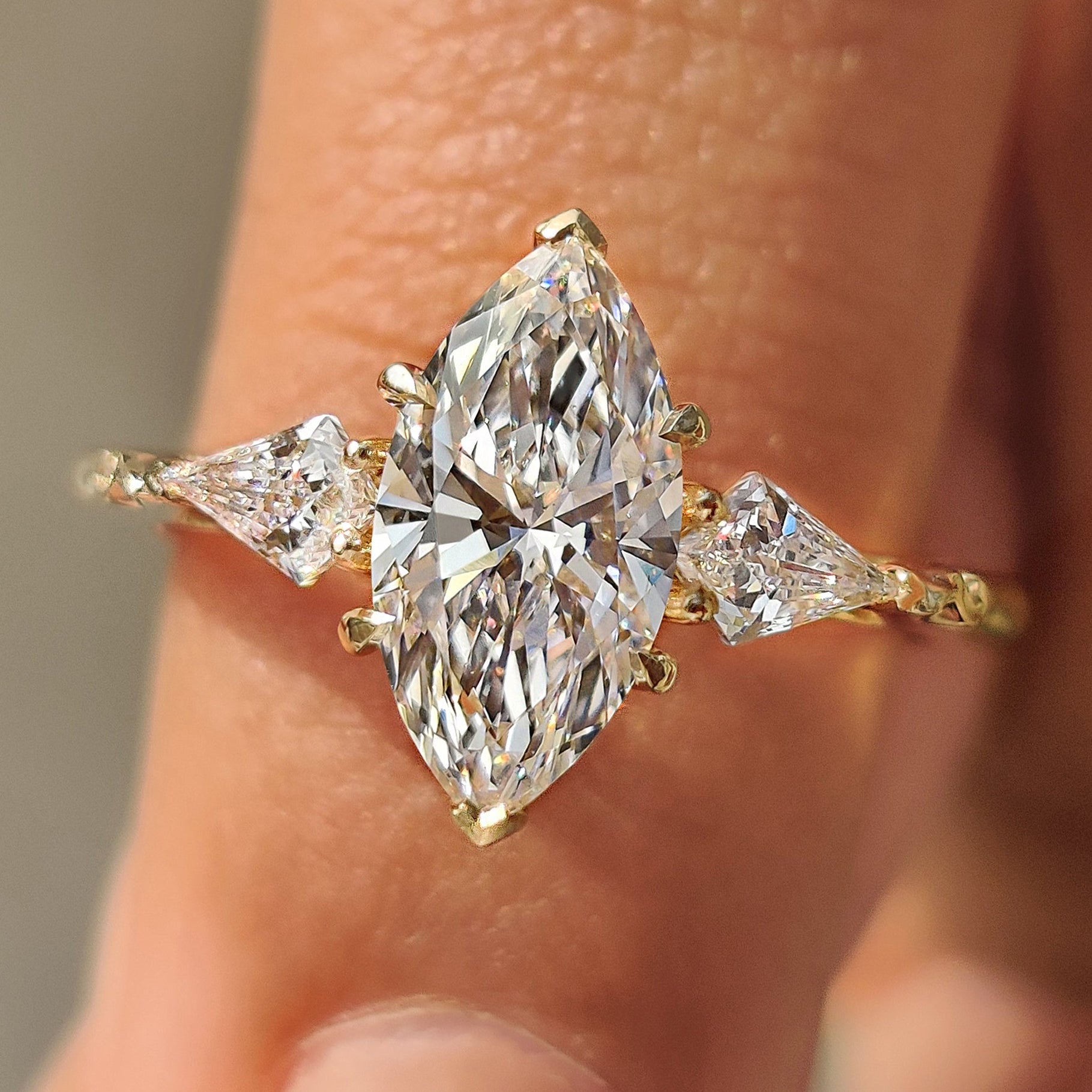


Milgrain edging along the setting border, hand-engraved metalwork on the basket or shank, and filigree detailing beneath the stones are commonly found in three stone rings with Victorian or Edwardian design references. These details suit center stones with antique-style cuts, such as old European round, old mine, or rose-cut diamonds, as well as modern stones in vintage-influenced settings.
Modern and Asymmetrical Designs

Not all three stone rings follow a perfectly symmetric left-center-right format. Some current designs use asymmetrical stone placement, graduated sizing across all three stones rather than just the center, or sculptural prong work that gives the setting a more contemporary character. These designs tend to appeal to buyers who want a ring that reads as personal and considered rather than conventional.
Low-Profile Three Stone Rings
Low-profile three stone settings keep the stones closer to the finger, reducing the overall height of the ring above the band. This is a practical consideration for everyday wear, since lower-profile designs are less likely to catch on fabric or present obstacles during physical activity. Bezel-set side stones in particular suit a low-profile approach while also offering strong stone protection at the edges.
Which Diamond Shapes Work Best in Three Stone Ring?
Most standard diamond shapes can work in a three stone format, but certain pairings produce more visually balanced results than others. Pointed or directional shapes work well as side stones because they naturally frame the center stone.

Oval center stones pair naturally with pear-shaped sides because the teardrop orientation of the pears directs attention inward toward the center. Cushion centers work well with half-moon, trillion, or tapered baguette sides because the rounded corners of the cushion are complemented by the geometric character of those shapes. Elongated center stones such as radiant and emerald cuts suit tapered baguettes because the parallel lines carry through the design coherently.
The key principle in any mixed-shape combination is that the side stones should frame the center rather than compete with it. Whether through matching color, visual flow, or deliberate contrast, the goal is to keep the eye naturally focused on the center stone.
Choose Right Three Stone Engagement Ring

Choosing the Center Stone
The center stone sets the visual tone and the budget anchor for the ring. Start with your preferred shape, then consider carat weight based on how the stone will look and sit on your finger. Elongated shapes like oval, pear, and radiant often appear larger per carat because they cover more finger surface. For more on how clarity grades affect diamond appearance, the VS1 vs VS2 clarity guide covers the practical differences.
Choosing the Side Stones
Side stones should complement the center stone in color and clarity rather than match exactly. A noticeable clarity difference between the center and side stones can make the ring appear inconsistent, especially if visible to the naked eye. Color matching between the center and side stones is generally more visible than clarity differences. Aim for side stones within one color grade of the center stone as a general approach, though this can be adjusted depending on whether you are intentionally introducing a color contrast.
Balancing Proportion and Visual Weight
Visual balance between the center and side stones is one of the most important decisions in a three-stone ring. Side stones that are significantly too large can compete with the center stone for visual attention, while smaller ones may appear like an afterthought. As a starting point, aim for side stones measuring 50–75% of the center stone’s face-up width, depending on the shapes and overall design. View finished rings in the actual combination before deciding.
Matching or Mixing Diamond Shapes
Matching shapes produce a unified, cohesive result. Mixed shapes produce visual contrast and allow for more individual character. Neither approach is objectively better. The decision should reflect personal aesthetic preference rather than convention.
Choosing Metal and Setting
Setting choice affects how secure the side stones are, how much metal is visible around them, and how the ring pairs with a wedding band. Bezel and trellis settings offer strong stone security. Prong settings expose more of each stone. Metal choice affects overall tone and maintenance. White gold requires periodic rhodium replating. Rose gold and yellow gold do not. Platinum offers durability without color drift.
Considering Everyday Wear

Three stone rings with pointed or angular side stones such as pear, marquise, or kite shapes require setting styles that protect the pointed ends. For wearers with active hands, lower-profile settings and side stones with bezel or V-prong protection are worth prioritizing. Regular professional inspection of prong and bezel integrity is advisable, particularly for intricate three-stone configurations.
Three Stone vs Solitaire Engagement Rings
| Factor | Three Stone Ring | Solitaire Ring |
|---|---|---|
| Visual style | More detailed and expressive | Clean and minimal |
| Finger coverage | Covers more finger surface | Focuses on one center stone |
| Design flexibility | Multiple stone shapes and combinations | Primarily centered around one stone |
| Symbolism | Often carries built-in meaning | Meaning depends more on the individual design |
| Wedding band pairing | May require more consideration | Usually easier with a straight band |
| Best for | Buyers wanting more visual detail | Buyers wanting maximum focus on one stone |
Neither is universally preferable. The choice depends on the wearer’s visual preferences and desired day-to-day comfort.
Pair Wedding Band with Three Stone Ring
Wedding band pairing depends on the height and profile of the three-stone ring rather than the style itself. High-profile settings often leave a visible gap between the engagement ring and a straight wedding band. In those cases, a curved or contour band designed to follow the engagement ring’s silhouette fills that gap more naturally. Browse curved wedding bands at Carat Diamonds for options designed to complement engagement rings with varied profiles.
Low-profile three-stone rings with stones set closer to the finger can often sit flush against a straight band with no gap, making standard flat or pavé bands a straightforward option. The best approach is to bring or photograph the engagement ring alongside potential wedding bands before purchasing.
Customize Your Past Present Future Ring
Three stone rings are among the most customizable ring designs available because every element – center stone, side stones, metal, setting, and shank – can be specified individually. Customization allows buyers to match the ring to a personal story, a specific combination of stones with individual significance, or a design language that does not exist in standard collections. For buyers interested in a fully custom approach, the custom jewelry design service at Carat Diamonds handles the process from concept through the finished ring.
Final Thoughts
A past present future ring can carry a shared story, represent a personal milestone, or simply reflect a preference for a design with more depth than a single stone allows. The symbolism is flexible. The design range is broader than the phrase “past, present and future” alone suggests.
For buyers who know roughly what they want, browsing existing three-stone designs offers a useful starting point. For buyers who have a specific combination in mind, customization allows every element to be built to intention. Either way, a three stone ring chosen with care and purpose is one of the most personal things a ring can be.
Browse Past, Present & Future Rings
Ready-to-ship designs or fully custom options available.


