

There is something about a marquise diamond that looks like it belongs to the natural world. The elongated, pointed silhouette echoes the shape of a leaf, a petal, or a wing, and that is not a coincidence; jewelers have overlooked that. When botanical and organic design details meet the marquise cut, the result is a ring that feels genuinely grown rather than assembled.
What is worth knowing in 2026 is that this category has moved well beyond simple leaf bands and vine engravings. Today’s designs range from botanical clusters to marquise and amethyst combinations with branch-inspired shanks, each creating a distinct look. This guide covers eight distinct starting points, with practical guidance on protecting the stone, choosing the right metal, and pairing the ring with a wedding band.
Why Marquise Suits Nature-Inspired Designs
The marquise cut has two defining features: its elongated form and its two sharp, pointed ends. Both of those qualities find a natural visual echo in the organic world. When set vertically, a marquise diamond naturally resembles a leaf, bud, or feather more closely than round or cushion cuts. When a designer adds leaf-style prongs, a vine-textured shank, or a floral element around it, the stone itself becomes part of the botanical story rather than simply sitting inside it.
This compatibility gives nature-inspired marquise rings a coherence that can feel lacking in other shape-and-style combinations. The design is not applied over the diamond. It extends from it. For buyers who want a ring that feels like a cohesive object rather than a decorated setting, that distinction matters.
8 Nature-Inspired Marquise Ring Ideas for 2026
Leaf and Vine Marquise Engagement Ring
The classic entry point of nature-inspired marquise design, done well, remains one of the most compelling choices available. A vertically set marquise diamond, held by six leaf-style prongs that curl around the stone like new growth, set above a band where delicate vine detailing weaves through small round accent diamonds. The result reads as “botanical” without being literal. For more leaf, vine, and floral-inspired engagement ring ideas, explore our guide to Top 10 Nature Inspired Engagement Rings Inspired by Leaves, Vines & Blooms.
This design works in yellow gold for a warmer, sunlit feel, or in rose gold for something that leans slightly romantic. It is the most versatile of the eight ideas here and suits buyers who want a recognizable nature theme without committing to a more unconventional orientation or stone combination.

Botanical Halo With Petal Details
Instead of a standard round halo, a petal halo uses individual metal leaves or teardrop-shaped stones arranged around the marquise center to suggest a flower in full bloom. The marquise sits at the center like a stamen, with the petal arrangement radiating outward.
This design amplifies the face-up presence of the ring considerably and works particularly well in white gold, where the contrast between the metal petals and a colorless center stone is most visible. One practical note: petal halos benefit from V-prongs at the pointed ends of the marquise to maintain clarity of the silhouette against the busy surrounding detail.

Twig and Branch Textured Marquise Ring
A twig-textured shank takes the botanical idea in a more atmospheric, less symmetrical direction. Instead of polished vine curves, the band uses organic irregular texture to suggest actual bark, branch sections, or forest growth. The marquise diamond sits above this texture in a relatively clean setting, creating a contrast between the stone’s geometric brilliance and the rough organic character below it.
This design is particularly well-suited to buyers who prefer woodland or outdoor aesthetics over floral ones, and it reads strongly in oxidized yellow gold or darker rose gold where the texture gains shadow and dimension.
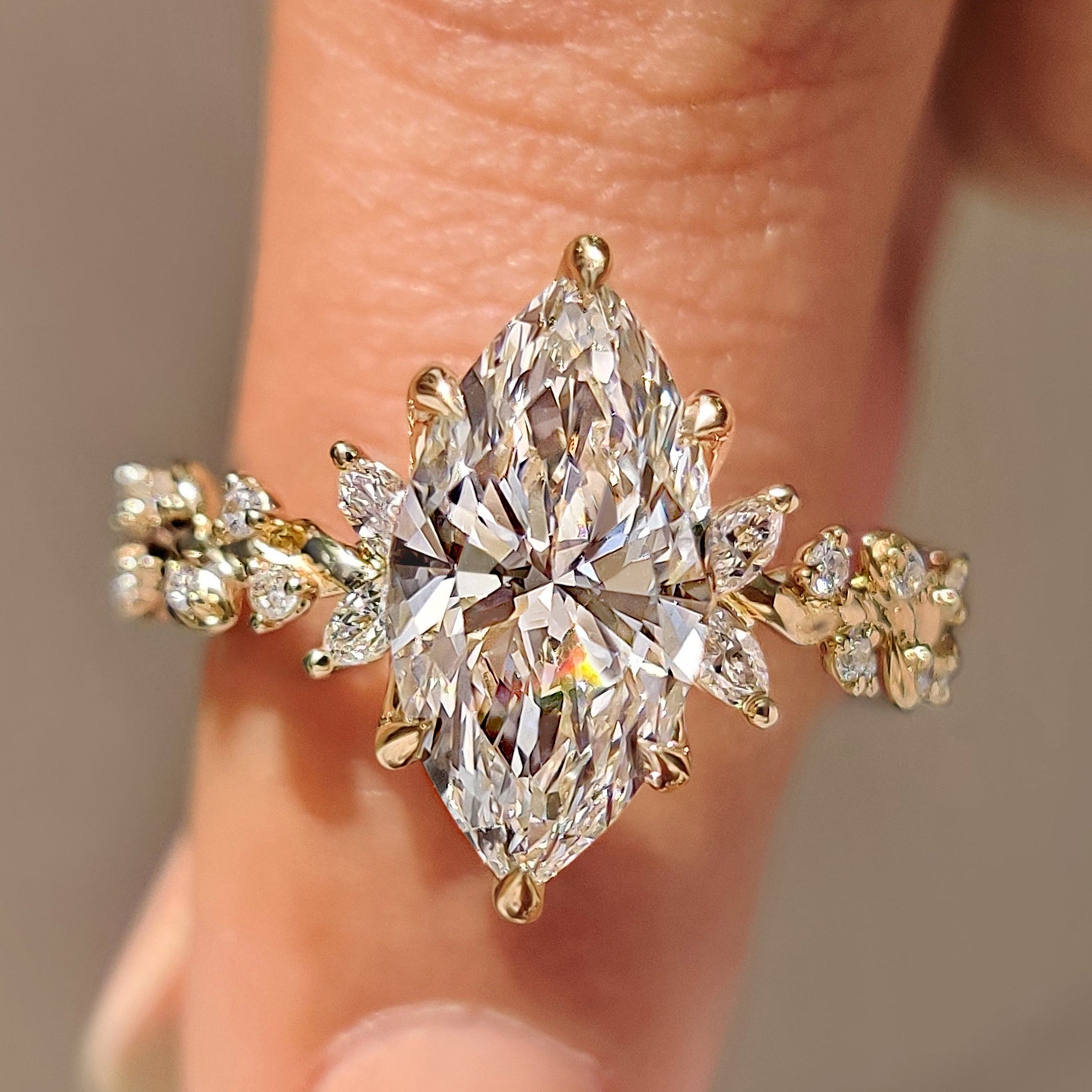
Marquise and Amethyst Nature-Inspired Design
Pairing a marquise diamond with amethyst brings a touch of natural color to a botanical-inspired engagement ring. The elongated marquise center keeps the design refined, while the rich purple of amethyst creates a distinctive contrast that feels more unexpected than an all-diamond setting.
This combination works especially well with yellow gold, which complements both the warmth of the metal and the deeper tones of the gemstone. For buyers who want a nature-inspired marquise ring with color and personality, amethyst offers a unique alternative to traditional diamond accents.
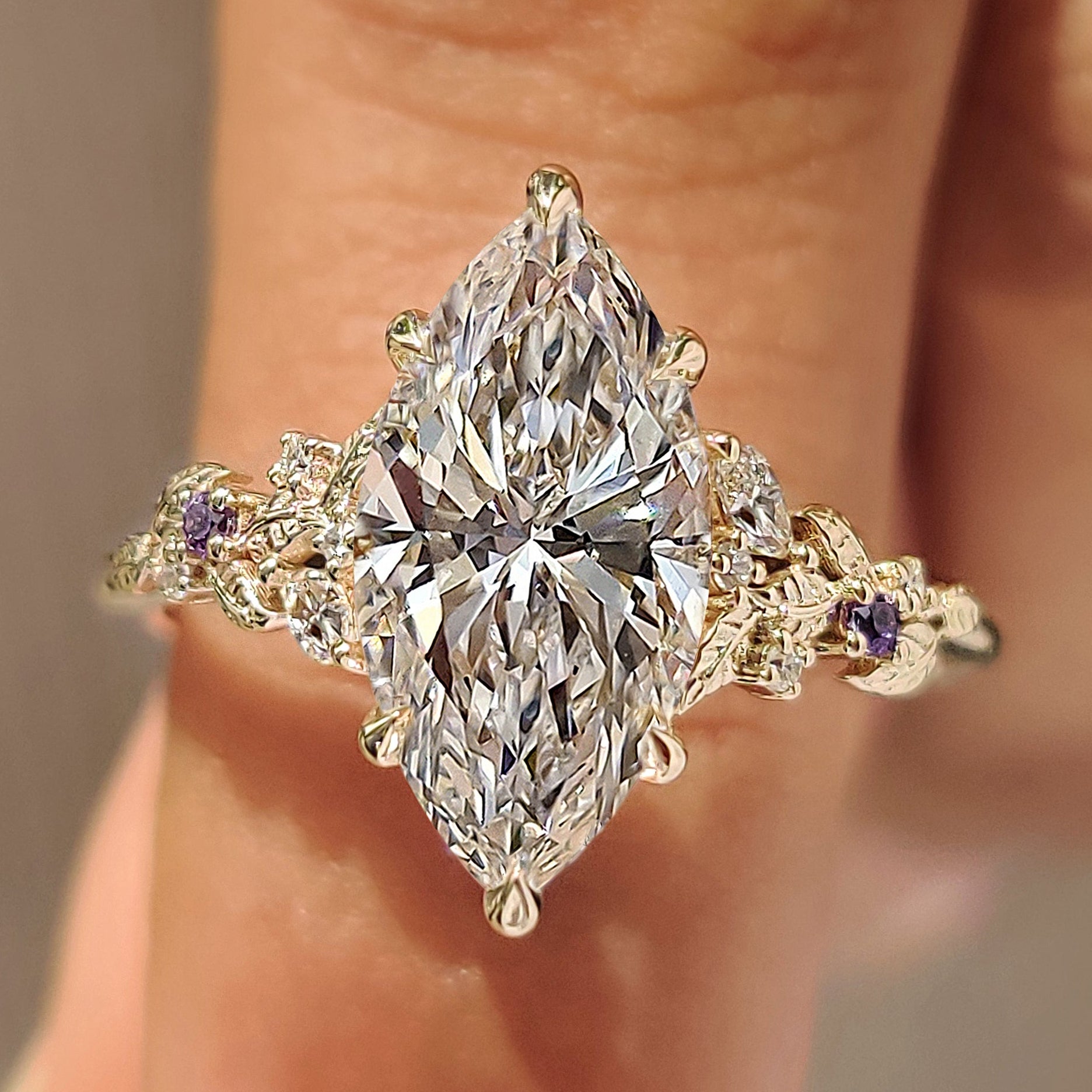
Marquise With Botanical Accents
A traditional marquise diamond already has a naturally leaf-like silhouette, which makes it especially well suited to botanical accents. Leaf-style prongs, small round accent diamonds, floral side details, or a flowing vine-inspired band can build on that shape without taking attention away from the center stone.
This combination works particularly well in yellow or rose gold, where the organic details feel warmer and more pronounced. It is a strong choice for buyers who want a clearly nature-inspired ring while keeping the classic marquise diamond as the focal point. See the full range of Marquise engagement rings at Carat Diamonds.

Leaf Style Prongs for a Marquise Diamond
This is the most minimal interpretation of nature-inspired marquise design and one of the most elegant. Instead of adding decorative elements to the band or halo, the prongs themselves are shaped as leaves. Each prong curves and tapers in a way that suggests a leaf holding the diamond from below, so the stone appears to rest in natural growth rather than a manufactured setting.
This works in any metal and keeps the overall ring clean and understated. For buyers who prefer minimalist aesthetics but still want the botanical reference to be visible, leaf-style prongs are the most efficient way to achieve it without additional complexity.
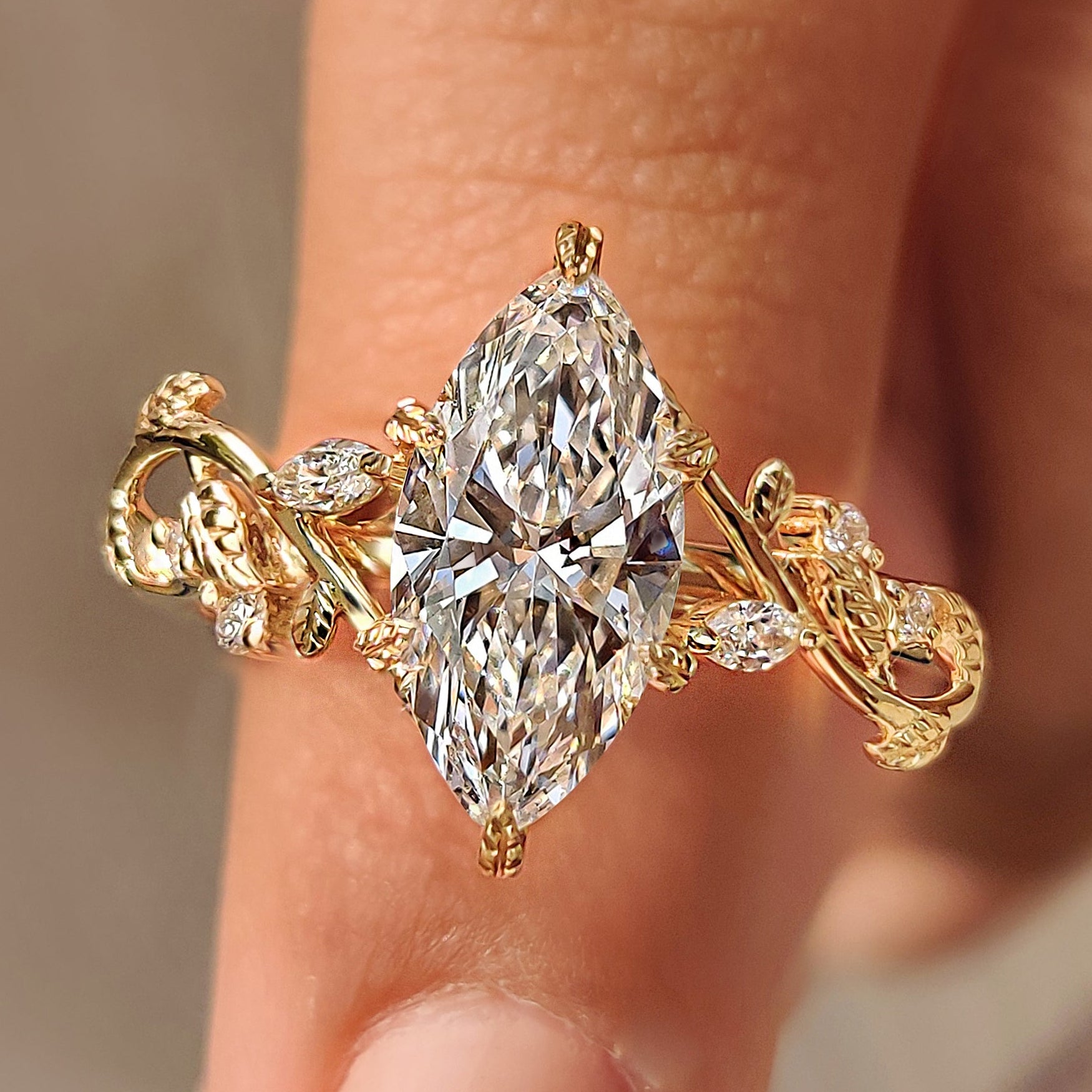
Marquise and Moss Agate Nature-Inspired Design
Replacing traditional diamond accent stones with moss agate introduces genuine color and texture into a nature-inspired marquise ring. Moss agate, with its green organic inclusions suspended in translucent stone, already looks as though it was grown rather than cut. Set as side stones flanking a lab grown diamond marquise center, the combination produces a ring that is visually unlike most engagement rings and requires no additional organic detailing to read as botanical.
Yellow gold is the most harmonious metal pairing for moss agate because it echoes the stone’s warm, earth-toned inclusions. This design is best suited to buyers who actively want their ring to include natural color and are comfortable with a more unconventional stone combination.

Vintage Botanical Marquise Engagement Ring
A vintage botanical marquise ring combines nature-inspired details with decorative elements that give the design more character and depth. Milgrain edging, engraved floral details, filigree-inspired metalwork, and small accent diamonds can frame the marquise center stone while keeping its elongated shape as the focal point. These details work especially well for buyers who prefer a ring with more visual texture than a clean modern setting.
White gold and platinum can make fine milgrain and engraved details stand out, while yellow or rose gold can give the design a warmer, more antique-inspired feel. For buyers who want a nature-inspired marquise ring with intricate details and a stronger sense of character, this style offers a more decorative alternative to minimalist botanical designs.

How to Protect a Marquise Diamond in an Organic Setting
The two pointed ends of a marquise diamond are the stone’s most vulnerable areas. Any organic or botanical setting must address this directly. V-prongs, which cup each pointed end in a protective metal V shape, are the standard solution and are compatible with almost every nature-inspired setting direction, including leaf prong designs and botanical halos. Partial bezel settings, where the bezel wraps the pointed ends but not the full stone, are an alternative for buyers who want stronger protection without a fully enclosed look.
The practical concern with highly ornate botanical settings is that intricate metalwork around the center stone can make it harder to inspect prongs regularly. When choosing a botanical marquise ring for everyday wear, confirm that the jeweler can access the prong tips for inspection and tightening without dismantling the setting. A well-executed nature-inspired ring should protect the stone as effectively as any standard solitaire.
Best Metal for a Nature-Inspired Marquise Ring
Each metal changes the visual character of a botanical marquise design significantly.
Rose gold reads as the most romantic and vintage-compatible choice. Its warm pink tone softens the marquise’s sharp silhouette and amplifies the handcrafted quality of leaf and vine detailing.
Yellow gold carries the strongest connection to natural materials and earth tones. Moss agate combinations, twig-textured shanks, and vintage botanical designs look most cohesive in yellow gold because the metal itself suggests the warmth of natural materials.
White gold allows botanical details to read with the most visual precision. Milgrain, filigree, and petal halos show the most contrast and definition against a white metal surface, which suits buyers who want the craft detail to be fully visible.
Platinum is the most durable option and maintains its color without replating, making it a practical choice for intricate settings that would be difficult to replate later. It has a slightly cooler, grayer tone than white gold, which can give botanical designs a more contemporary character.
Pairing Marquise Ring with Wedding Band
The organic detailing on a nature-inspired marquise ring is worth protecting when pairing with a wedding band. Straight bands with significant pave or diamond coverage can crowd the botanical shoulder details and make the full ring design harder to read.
Curved or contour bands that follow the profile of the engagement ring’s shank allow the two rings to sit flush without hiding the leaf or vine elements. A slim, plain band in the same metal lets the botanical engagement ring remain the visual focus. A delicate pavé band works if it is narrow enough to sit below the shoulder details rather than alongside them.
For rings with significant filigree or milgrain work on the shank shoulders, a stackable band worn slightly separated can be a deliberate styling choice. Browse curved wedding bands for options designed to complement rings with detailed shanks.
Why Lab Grown Diamonds Suit Detailed Rings
Lab grown diamonds offer a specific practical advantage for botanical marquise ring buyers. Detailed nature-inspired settings typically cost more than standard solitaires because of the additional labor and material involved in leaf prong work, vine band detailing, or custom filigree. Choosing a lab grown diamond for the center stone allows buyers to direct more of their budget toward the setting, craftsmanship and distinctive design details that make a botanical ring valuable.
A lab grown marquise diamond is identical in appearance, hardness, and optical performance to a natural marquise diamond. For a ring where the design is the differentiating element, the origin of the center stone is unlikely to be visible to anyone looking at the finished piece. Find certified lab grown diamond engagement rings at Carat Diamonds available in marquise and other shapes.
Should You Choose Nature-Inspired Marquise Ring?
The strongest direction in fine jewelry right now is personalization, and nature-inspired marquise rings are a direct expression of that. Buyers are increasingly looking for rings that reflect personal aesthetics rather than standard categories. Botanical and organic design allows for a wide range of individual interpretation, from the minimal (leaf-style prongs only) to the complex (full botanical cluster with colored accent stones).
The marquise cut specifically has gained renewed attention because of its unusual combination of distinctive silhouette and practical benefits, including a face-up appearance that is larger per carat than round brilliants. Set within a botanical design direction, it is one of the few combinations that is simultaneously distinctive and grounded in a clear design logic.
Mixed metals, vintage references, colored gemstone combinations, and east-west orientations are all currently attracting buyer interest. Nature-inspired marquise rings touch several of those directions at once.
Choosing Nature-Inspired Marquise Ring
Choose the marquise orientation first. Vertical settings emphasize the leaf-like silhouette most directly, while the overall design can then be personalized through botanical details, gemstone accents, or the choice of metal.
Decide how organic you want the design to feel. Leaf prongs alone read as subtle. Full vine-covered shanks with accent stones read as committed.
Choose the metal based on the feeling you want. Rose gold for warmth and romance. Yellow gold for earthy character. White gold or platinum for visible craft detail.
Confirm pointed-end protection. V-prongs or partial bezels should be part of any marquise setting.
Think about the wedding band before finalizing the engagement ring. Some botanical designs leave more room for band pairing than others.
Consider whether custom design makes sense. If no existing ring feels like exactly the right combination, custom jewelry design at Carat Diamonds allows full control over every design element.
Conclusion
A marquise diamond and a nature-inspired setting are not a coincidence of design. The stone’s silhouette and the organic vocabulary of botanical jewelry are genuinely compatible in a way that allows each element to strengthen the other. Whether the starting point is a leaf-prong solitaire, a marquise in a vine cluster, or a vintage botanical design with milgrain and filigree, the result is a ring that reads as personal and considered rather than simply decorated. The eight ideas in this guide are starting points, not limitations.
Create Your Nature-Inspired Ring🍃
Customize your marquise diamond, botanical details, setting, and metal to create a design that feels personal to you.


