

Picking an engagement ring is one of the most personal purchases most people will ever make. The style you choose reflects personality, taste, and how you want to be seen, not just on the day of the proposal but every day after. This guide covers every major engagement ring style, from classic to completely custom, so you can approach the decision with confidence.
Popular Engagement Rings 2026
Solitaire Engagement Rings
A single center stone, a clean band, nothing else. The solitaire is the most popular engagement ring style in the world because it genuinely works for everyone. It suits every diamond shape, every metal color, and every hand type. A round brilliant or oval lab grown diamond in a four or six prong solitaire setting puts the stone front and center, which is usually exactly the point. If you want a ring that will never feel dated and never compete with the stone itself, this is the starting point.
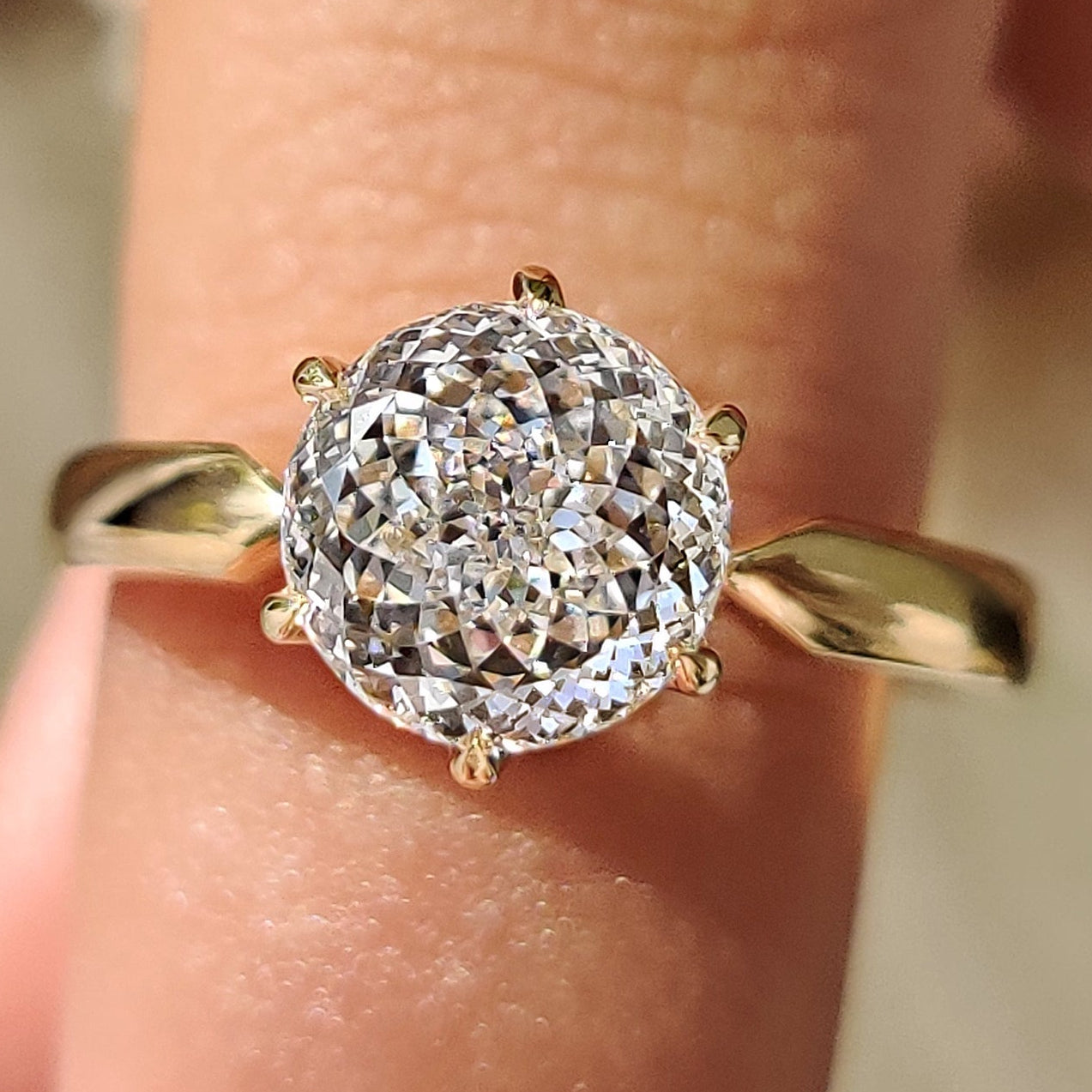
Solitaire Style Portuguese Cut Diamond Ring
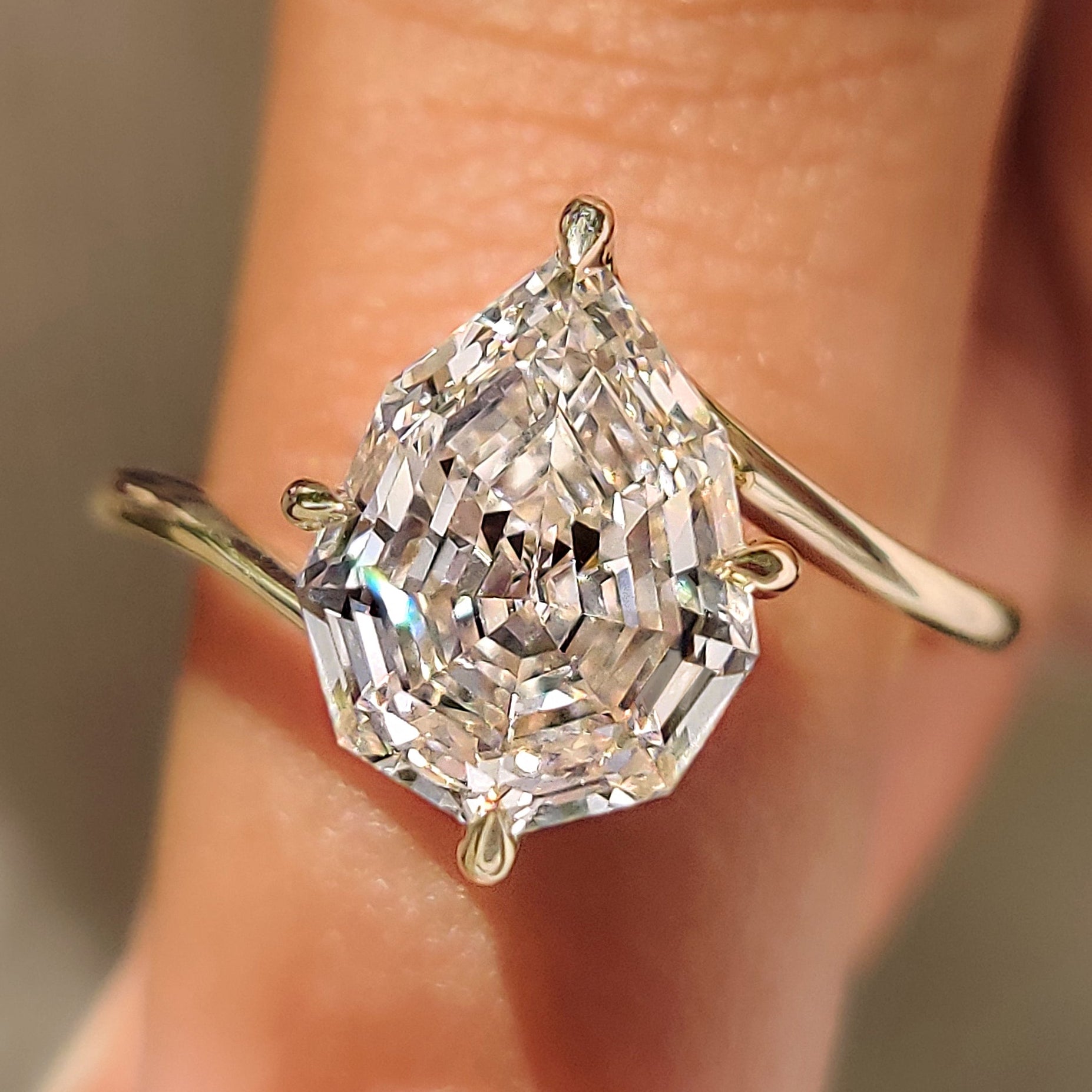
Pear Step Cut Diamond Solitaire Engagement Ring
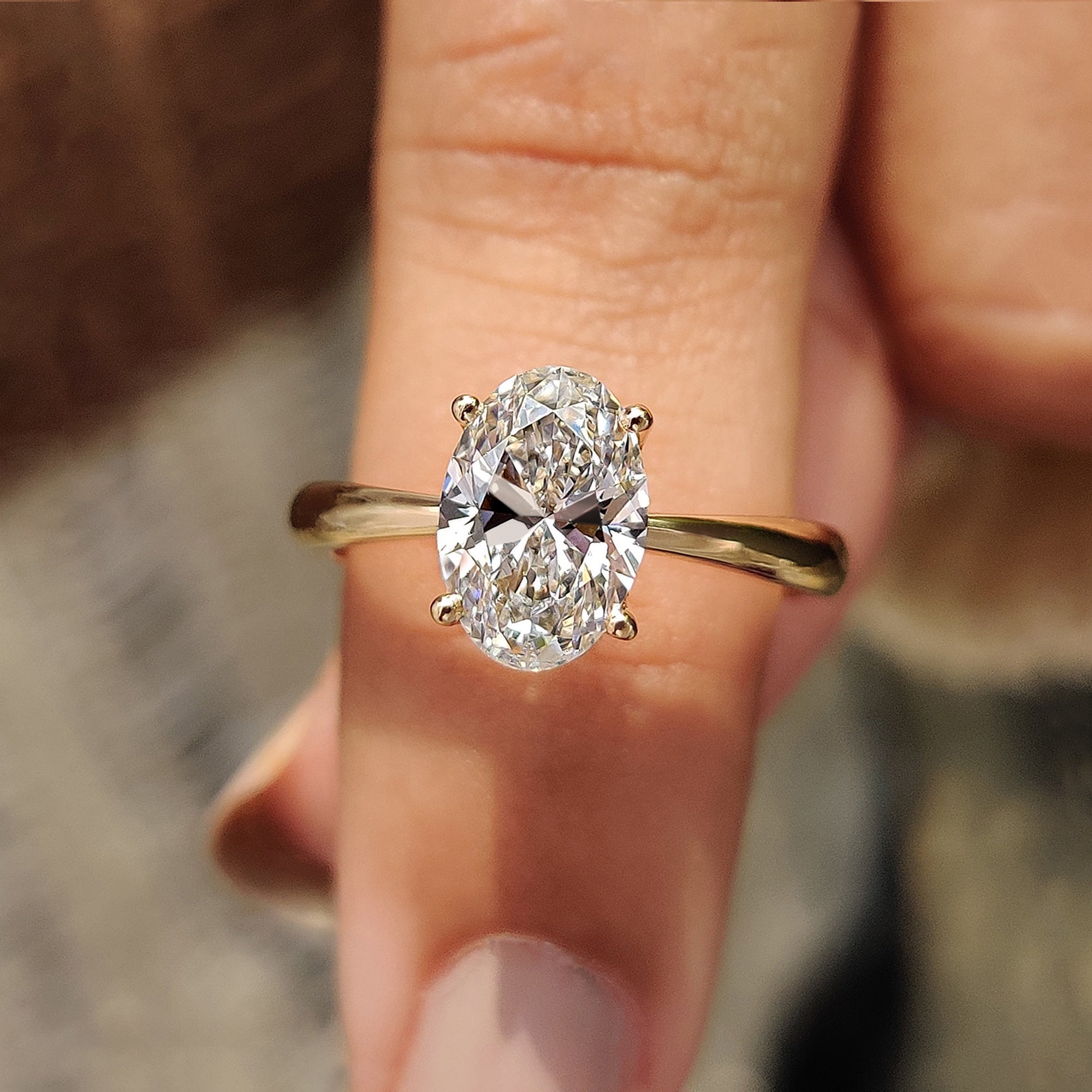
Oval Cut Engagement Ring In Solitaire Style
Halo Engagement Rings
A halo surrounds the center stone with a ring of smaller diamonds, adding sparkle and making the center stone appear larger than it actually is. This is one of the most practical style choices for buyers who want maximum visual impact at a reasonable price point; the halo does a lot of the work. Double halos add even more drama. Cushion and round brilliant cuts are the most popular center stone choices for classic halos, though oval halos have become a strong alternative.
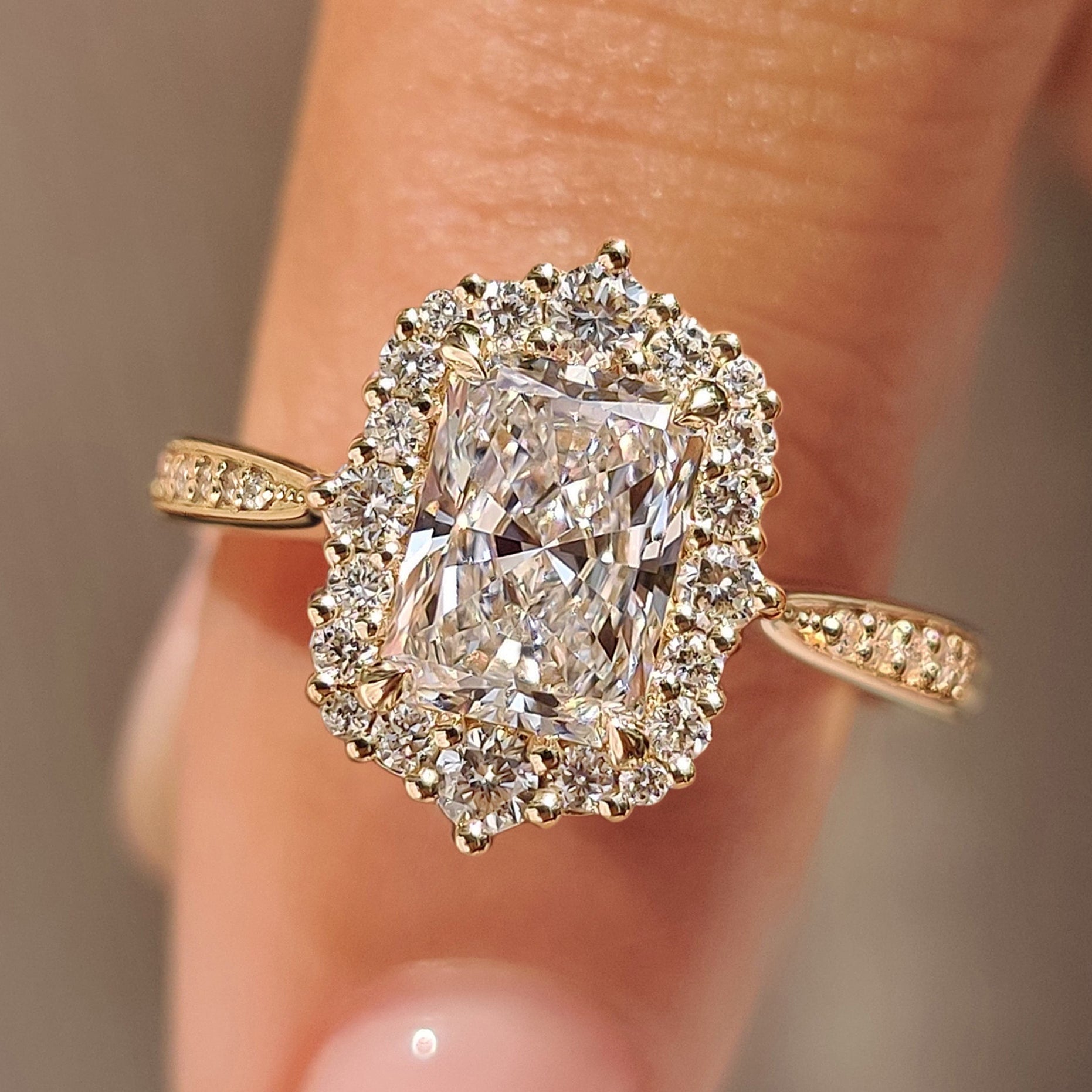
Radiant Cut Ring with Halo Style
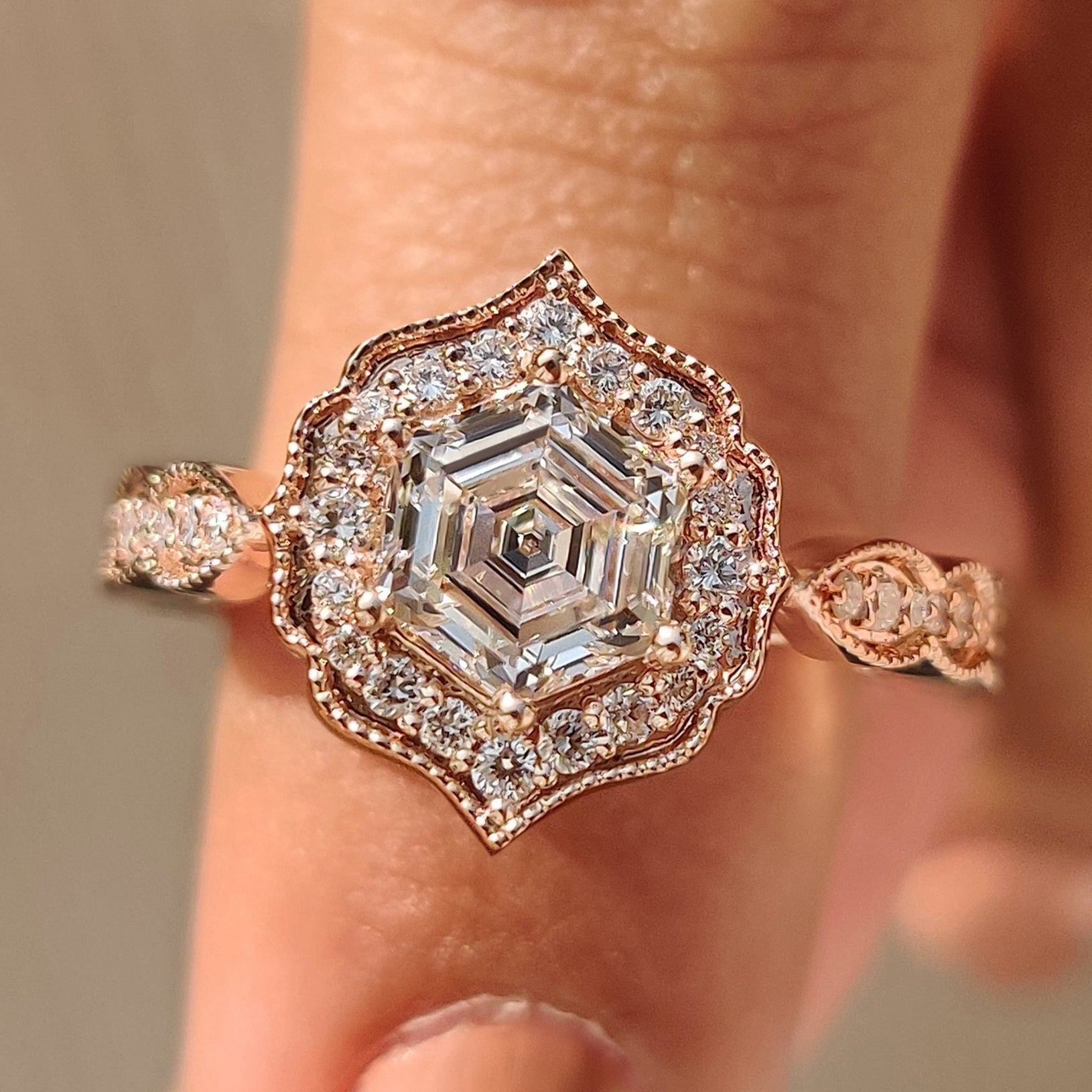
Hexagon Diamond Ring in Halo Style
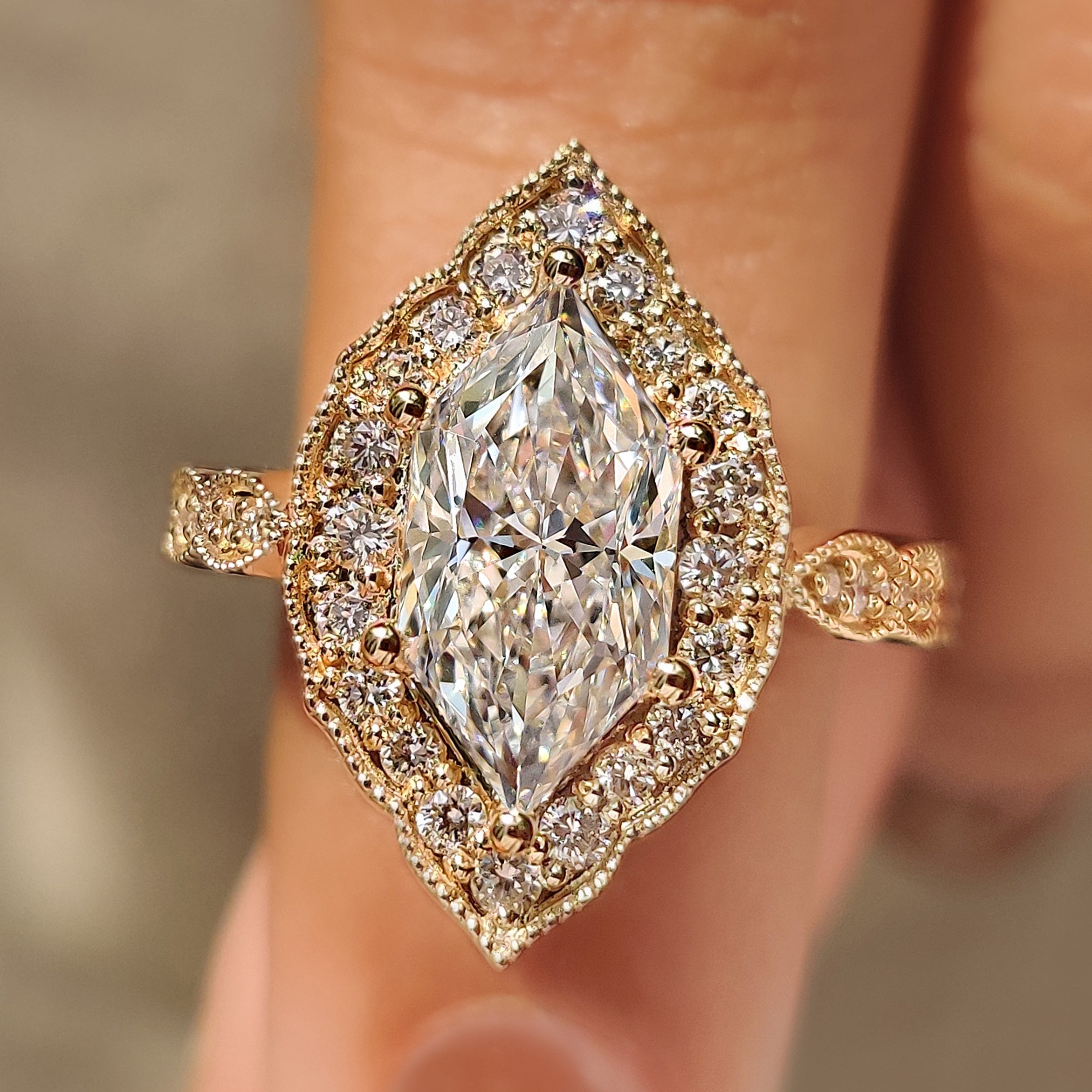
Dutch Marquise Halo Engagement Ring
Three Stone Engagement Rings
Similarly, three stone rings feature a center diamond with two side stones, traditionally representing the past, present, and future of a relationship. The side stones can match or contrast the center stone shape. An oval center with two pear shaped sides, for example, creates a very elegant look. It works well with lab grown diamonds or moissanite side stones, where the budget saved on the accents can go toward a better quality center stone.
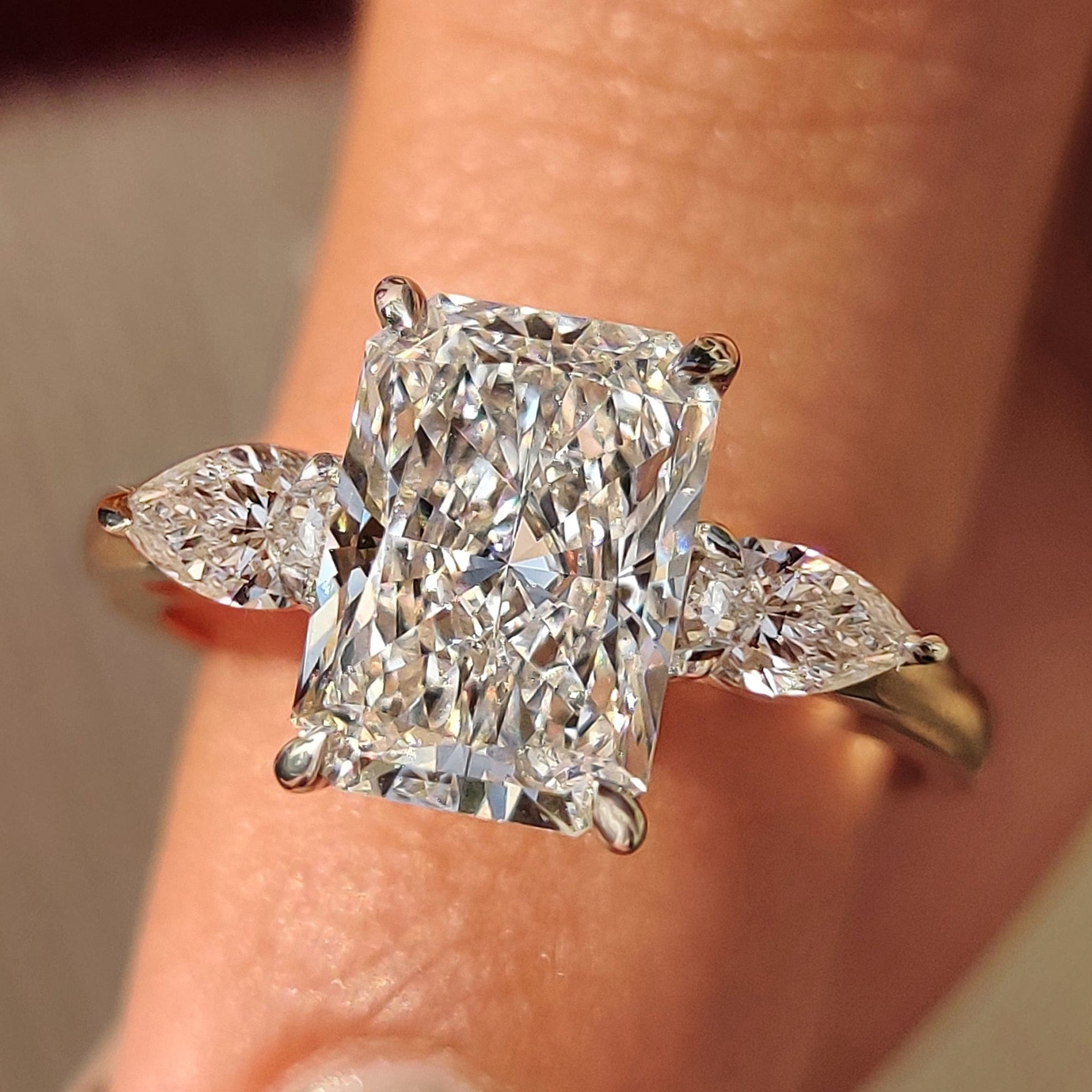
Radiant Cut Diamond Ring With Pear Side Stones
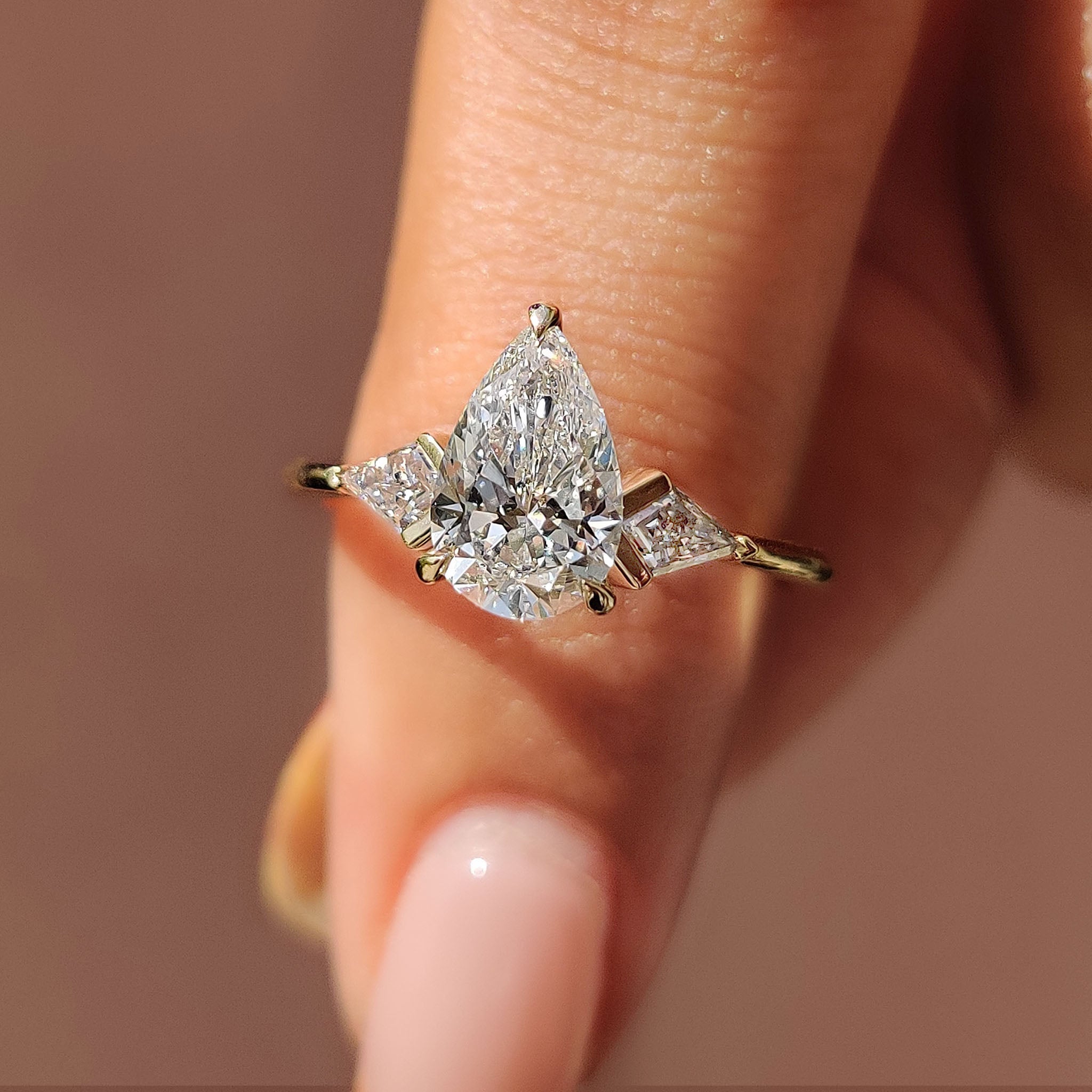
Three Stone Pear Cut Diamond Engagement Ring
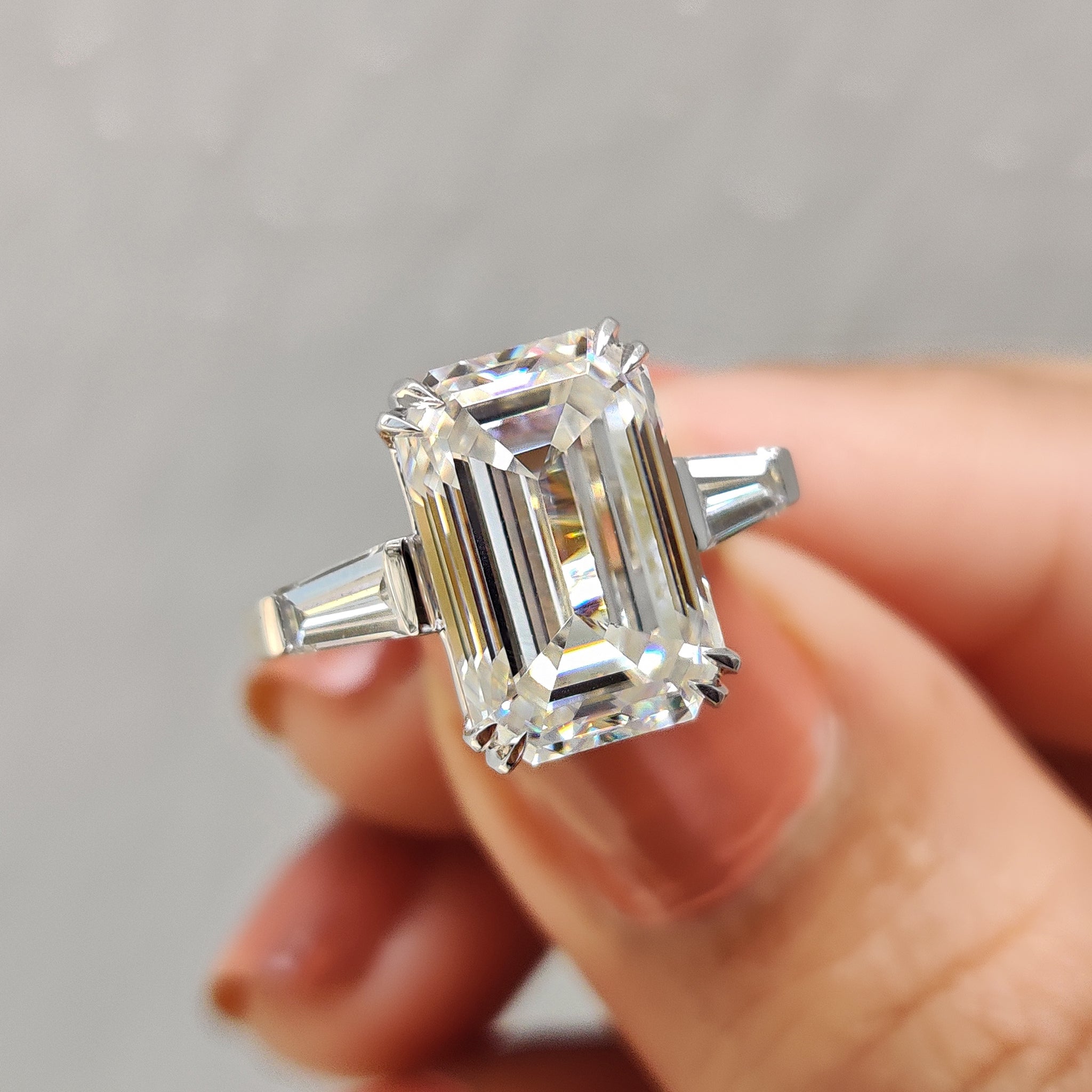
Emerald Cut Engagement Ring With Tapered Baguette Side Stones
Unique Engagement Rings

Dutch Marquise Engagement Rings
The Dutch marquise is a softer, rounder version of the traditional marquise cut, wider through the center and less pointed at the tips. Its vintage character pairs naturally with yellow gold and hand-engraved settings, while also looking beautiful in modern white gold.
Dutch marquise diamonds are less widely available than standard cuts, which makes them a good choice for buyers who want something distinctive without going fully custom. Another advantage is that the rounded tips reduce the chipping risk associated with sharper, pointed stones.

East West Engagement Rings
In an east west setting, the center stone is rotated 90 degrees and set horizontally across the finger rather than vertically. This simple change in orientation completely transforms the look of the ring. Elongated shapes work best here, oval, marquise, emerald, and baguette cuts all read beautifully in this position.
The style suits buyers who want a modern, architectural look without adding extra stones or detail. It photographs well and tends to flatter a wide range of finger shapes.

Hidden Halo Engagement Rings
Meanwhile, a hidden halo places small diamonds underneath the center stone, set into the gallery or basket rather than visibly around it. Viewed from above, the ring looks like a clean solitaire. When seen from the side, there is a ring of sparkle that catches light with every movement.
Many buyers choose this over a traditional halo because it adds depth and brilliance without changing the profile of the ring or drawing attention away from the center stone. It is one of the more elegant ways to add detail without adding bulk.

Toi et Moi Engagement Rings
On the other hand, “Toi et moi” translates from French as “you and me,” two stones, one ring, representing two people. The style has surged in popularity following high-profile celebrity proposals and has found a strong following among buyers who want a ring that tells a story.
The most popular combinations pair different shapes, oval and pear, round and marquise, or emerald and round, often in contrasting sizes. Mixing a diamond with a colored stone, such as a sapphire or an emerald, adds another layer of personal meaning.

Kite Cut Diamond Engagement Rings
For those seeking something different, A kite cut diamond has a geometric, four-sided shape with two longer sides and two shorter sides that come to a point at the top and bottom. It is an unusual shape that very few jewelers work with, which is exactly why it has become a signature choice for buyers who are drawn to avant-garde or artistic jewelry.
Kite cuts have a flat, angular appearance that works particularly well in minimal settings that let the shape speak for itself. If your aesthetic leans toward contemporary art more than traditional jewelry, this is worth exploring.

Hexagon Diamond Engagement Rings
Hexagon diamond rings draw on architectural and geometric influences, creating a ring that feels more like a design object than a conventional piece of jewelry. The six-sided outline is distinctive from every angle, and the flat facets of a hexagonal stone, often a rose cut or table cut, produce a soft, diffused glow rather than the intense brilliance of a brilliant cut.
These rings suit buyers who appreciate considered design and want something that feels more like wearable art.

Pear Cluster Engagement Rings
A pear cluster ring uses multiple smaller pear-shaped diamonds arranged together to create the appearance of a single larger stone. The stones are typically set in a floral or sunburst pattern, giving the ring a vintage, romantic quality that sits somewhere between antique and contemporary.
This design allows buyers to achieve a large, dramatic look at a significantly lower cost than a single large center stone, and the cluster arrangement means no two rings look exactly the same.

Salt and Pepper Diamond Rings
Likewise, Salt and pepper diamonds contain natural inclusions, tiny black and white flecks trapped inside the stone during its formation. Every stone has a completely unique pattern, which means every ring is genuinely one of a kind.
Buyers who choose salt and pepper diamonds typically do so because they value character and individuality over conventional standards of clarity. These stones are also more affordable than eye-clean diamonds of the same size, and they pair especially well with nature-inspired settings and rose or yellow gold.

Bezel Set Engagement Rings
A bezel setting wraps a thin rim of metal around the entire outer edge of the center stone, holding it securely without prongs. The result is a smooth, snag-free profile that suits active lifestyles. There is nothing raised or protruding to catch on clothing or get damaged during physical work.
Bezel settings also give the ring a clean, modern look that works across a wide range of stone shapes. Rose cut and oval diamonds are particularly popular choices for bezel settings, as the wide surface area of both shapes is fully visible from above.

Floating Diamond Engagement Rings
A floating diamond ring, also called an illusion setting, uses minimal metal contact with the stone to create the impression that the diamond is suspended in the air above the band. The bridge or prongs holding the stone are designed to be as invisible as possible.
This design is often confused with tension settings, but floating settings typically use very fine prongs or a minimal mount rather than spring pressure from the band. The visual effect is striking, modern, and far more dramatic in person than in photographs.

Open Gallery Engagement Rings
An open gallery ring has decorative cut-outs or open spaces in the band beneath the center stone. Most buyers never think about the underside of a ring, which is exactly why the detail here tends to surprise people.
Architecturally, the open gallery reduces the weight of the ring and creates a more airy, delicate profile. It also improves light entry to the stone from the bottom, which can enhance brilliance. These rings suit buyers who appreciate craftsmanship and hidden detail as much as the face-up appearance.

Nature Inspired Engagement Rings
In addition, Nature inspired rings draw from leaves, vines, flowers, and organic curves, incorporating them into the setting’s metalwork rather than just the overall shape. Leaf prongs, vine-wrapped bands, floral halos, and petal-shaped baskets all fall into this category.
These rings feel personal and handcrafted, and they pair naturally with lab grown diamonds and moissanite, both of which align with an environmentally conscious aesthetic. Buyers who love botanical aesthetics, garden settings, and organic textures tend to connect immediately with this style.

Art Deco Engagement Rings
By contrast, Art Deco jewelry is defined by bold geometric shapes, strong contrasts, and highly precise craftsmanship. Engagement rings from this period or inspired by it typically feature sharp angles, black and white color combinations, step-cut stones like Asscher and emerald cuts, and decorative milgrain edging.
The style carries genuine glamour and suits buyers who are drawn to the aesthetic of old Hollywood and architectural design. Asscher cut and emerald cut lab grown diamonds are among the most compatible center stones for an authentic Art Deco look.

Wide Band Engagement Rings
Another popular option is Wide-band engagement rings make a statement through proportion rather than decoration. A band that is noticeably wider than standard, usually 5mm or more, gives the ring a substantial, modern presence on the hand.
These rings suit buyers who want something that reads as luxurious without relying on extra stones or intricate detail. Wide bands work well with a single large center stone and minimal accent detail, letting the metalwork itself be part of the design. They tend to be especially flattering on wider fingers.

Sculptural Engagement Rings
Sculptural rings treat the metal band as a design element in its own right, with curves, twists, freeform shapes, and unexpected proportions that go beyond what a standard setting would do. These are genuinely artistic pieces, usually custom-made, that reflect the jeweler’s craft as much as the stone they hold.
If conventional engagement ring styles leave you cold and you want something that functions as wearable art, sculptural design is the direction to explore. No two sculptural rings look the same.

Cathedral Hidden Halo Engagement Rings
A cathedral setting raises the center stone on arching metal supports that sweep up from the band. When combined with a hidden halo of small diamonds set into the gallery beneath the center stone, the result is a ring with real presence and layered sparkle.
The elevated profile makes the center stone very visible, and the hidden halo adds light from below without visually competing with the stone from above. Many buyers choose this design who want height, drama, and elegance together.

Split Shank Engagement Rings
A split shank ring has a band that divides into two strands as it approaches the center stone, creating a wide, dramatic frame around the setting. The divided band draws the eye to the center and makes the ring look substantial from every angle. Round brilliant, oval, and cushion cut diamonds are the most common center stone choices for this style.
It suits buyers who want a ring that commands attention without being maximalist; the drama comes from the structure, not from added stones.

Bypass Engagement Rings
A bypass ring has two ends of the band that wrap around the center stone without meeting, crossing over, or flowing past each other in a continuous movement. The design creates a sense of fluidity and motion that static band designs cannot achieve.
It carries a symbolic quality, two paths converging, that appeals to buyers who want a ring with inherent meaning built into its structure. Bypass rings look particularly strong in yellow gold with an oval or pear center stone.

Asymmetrical Engagement Rings
Asymmetrical rings deliberately break the visual symmetry of a traditional engagement ring, with off-center stones, uneven prong arrangements, stones set at angles, or bands that vary in width from one side to the other. The style has grown steadily in popularity as more buyers move away from convention.
These rings suit people with an artistic sensibility who want something that looks considered and personal rather than conventional. They are often custom-made, and they photograph in a way that rewards looking closely.
Colored Stone Engagement Rings

Colored Diamond Engagement Rings
Colored diamonds bring a completely different energy to an engagement ring. Yellow and champagne diamonds have a warm, sunny quality that works beautifully in yellow gold settings. Black diamonds are bold and graphic, most effective in white gold or platinum.
Blue diamonds are rare and intensely saturated; a blue diamond ring is as much a collector’s piece as a piece of jewelry. Lab grown colored diamonds make these options accessible at a fraction of the cost of their natural equivalents.

Sapphire Engagement Rings
Blue sapphire engagement rings have a long history; they have been worn by royalty and remain one of the most requested non-diamond center stones. Sapphire sits at 9 on the Mohs hardness scale, making it an excellent choice for daily wear.
Beyond classic blue, sapphires come in pink, peach, teal, and white, which gives buyers significant room for personalization. A sapphire center stone with diamond accents in a halo or three stone setting is among the most popular combinations.

Emerald Engagement Rings
An emerald center stone gives an engagement ring a rich, saturated depth that diamonds and sapphires simply do not. Emeralds have a strong vintage association; they appear frequently in Edwardian and Art Deco jewelry, and they suit buyers who want something that feels genuinely rare and personal.
One practical consideration: emeralds rate 7.5 on the Mohs scale and can be more vulnerable to chips and scratches than diamonds or sapphires. A bezel or protective prong setting is worth considering for everyday wear.
Modern & Mixed Engagement Rings

Mixed Metal Engagement Rings
Mixing metals in a single ring, white gold and yellow gold, or white gold and rose gold, creates a visual contrast that neither metal achieves alone. A common approach is a yellow gold band with white gold prongs, which lets the warm metal tone show around the finger while keeping the diamond’s setting in a color that complements the stone.
Mixed metal rings suit buyers who already wear both gold tones and want the ring to work with their existing jewelry rather than clash with it.

Vintage Engagement Ring Styles
Vintage inspired rings draw from three main eras: Edwardian (soft, romantic, filigree-heavy, often in white metal), Victorian (more ornate, often combining yellow gold with darker stones and heavy engraving), and Art Nouveau (fluid, nature-influenced, with organic curves and enamel detail).
Modern versions of these styles use contemporary materials, including lab grown diamonds and moissanite, while recreating the handcrafted feeling of jewelry from those periods. The appeal is a ring that feels found rather than manufactured.
How to Choose the Right Engagement Ring Styles
The most reliable guide is what the person already wears. Someone who gravitates toward clean, minimal jewelry will likely feel out of place in an ornate halo. Someone who collects vintage pieces will want that sensibility reflected in the ring.
Lifestyle matters too. High-set stones and exposed pavé settings are more vulnerable during physical work, gym sessions, or hands-on professions. A bezel or low-profile prong setting offers more practical protection without sacrificing appearance.
The center stone shape should also inform the setting choice. Elongated shapes like oval, pear, and marquise can be set east-west or north-south, depending on the look you want. Step cuts like emerald and Asscher suit clean, geometric settings. Round brilliants are the most versatile and work in almost any style.
Lab grown diamonds and moissanite are available in every shape and setting shown in this guide. Both are IGI certified, physically identical to mined stones, and significantly more affordable at the same carat weight.
Best Engagement Ring Styles by Personality
| Personality | Recommended Style |
|---|---|
| Minimal and modern | East-west solitaire, bezel set, wide band |
| Romantic and sentimental | Toi et moi, three stone, nature-inspired |
| Bold and artistic | Kite cut, hexagon, sculptural, asymmetrical |
| Vintage lover | Old cut, Asscher, Art Deco, rose cut |
| Practical and active | Bezel set, low-profile prong, channel band |
| Maximalist | Halo, cathedral hidden halo, split shank |
| Understated luxury | Hidden halo, floating diamond, open gallery |
| Truly individual | Dutch marquise, salt and pepper, fully custom |
Popular Metal Choices by Style
| Ring Style | Recommended Metals |
|---|---|
| Solitaire | White gold, platinum, yellow gold |
| Vintage and Art Deco | Yellow gold, white gold with milgrain, rose gold |
| Nature-inspired | Rose gold, yellow gold |
| Modern minimalist | White gold, platinum |
| Salt and pepper | Rose gold, yellow gold |
| Colored gemstones | Yellow gold, rose gold |
| Bezel set | White gold, platinum, yellow gold |
| Wide band | Platinum, white gold |
Fully Custom Engagement Rings
A fully custom engagement ring starts from nothing. No existing mold, no off-the-shelf setting, no stone pulled from standard inventory. The design process begins with a conversation about personality, lifestyle, aesthetics, and budget and builds from there through sketches, digital renders, and handcrafted prototypes.
Custom rings are the most personal option in this guide and the most meaningful for buyers who cannot find what they want in any existing collection. Every stone, every proportion, every detail is chosen deliberately. The result is a ring that exists nowhere else.
If you have a clear idea of what you want, or if you have an idea that needs refining, Carat Diamonds works with you through every stage of the process to bring it to life.
Frequently Asked Questions
Conclusion
There is no universally correct engagement ring style. The right choice is always the one that fits the person who will wear it, their personality, their daily life, and the kind of jewelry they already love. This guide covers over 30 styles, from the familiar to the genuinely rare. Whether you are drawn to the quiet clarity of a solitaire, the layered sparkle of a hidden halo, or the artistic individuality of a sculptural custom ring, Carat Diamonds has the collections and the custom design expertise to help you find it.
Find the Engagement Ring Style That Feels Right
Explore expertly crafted engagement rings or work with Carat Diamonds to create a custom design that reflects your style and story.


